The Indian Defence Ministry has refuted media reports suggesting a pause in defence purchases from the US, clarifying that procurement processes are ongoing despite tariff tensions between the two countries.
'If the near-term economic pain is absorbed more by those who have the ability and the financial strength to do so, then small and medium enterprises in downstream industries will emerge stronger from the trade imbroglio.'
United States President Donald Trump has said India is 'very close' to China in terms of its purchases of Russian oil and will pay tariffs of 50 per cent as he indicated that 'you are going to see so much secondary sanctions'.
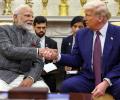
Prime Minister Narendra Modi congratulated US President Donald Trump on the success of the first phase of a US-brokered peace plan for Gaza and reviewed trade negotiations during a phone conversation.

The toll in the case reached nine in Madhya Pradesh while media reports said of two infants died in Rajasthan.
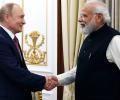
The US House Foreign Affairs Committee Democrats stated that imposing tariffs on India will not deter Russian President Vladimir Putin or address Russia's invasion of Ukraine.

India has strongly criticized the US and EU for their 'unjustified and unreasonable' targeting of New Delhi for its procurement of Russian crude oil, pointing out their own continued trade relations with Russia.

China's ruling Communist Party is holding its annual leadership conclave to discuss the new five-year plan, the impact of US President Donald Trump's tariff war, and the ongoing anti-corruption crackdown in the military.
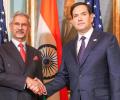
This will be the first face-to-face meeting between Rubio and Jaishankar following President Donald Trump's imposition of an additional 25 per cent tariff on India for Delhi's purchases of Russian oil, taking the total levies imposed on India by the Trump White House to 50 per cent.
'India has intentionally taken advantage of the war in Ukraine to dramatically increase its purchases of Russian crude, when there are roughly 40 major crude providers that could satisfy Indian demand.'

India's goods exports rebounded in July after two months of contraction, with outbound shipments rising 7.3 per cent to $37.24 billion, led by a surge in exports to the United States before the country's reciprocal tariff kicked in and bolstered by a recovery in exports to other key markets.

Prime Minister Narendra Modi conveyed to Ukrainian President Volodymyr Zelenskyy that India remains committed to making every possible contribution for an early and peaceful solution to the conflict. Zelenskyy sought India's support in limiting Russian energy exports.

US Ambassador-designate Sergio Gor emphasizes the importance of the India-US relationship after meeting with Prime Minister Narendra Modi, focusing on cooperation in defence, trade, and critical minerals.

The United States action of levying 25 per cent additional tariff on Indian goods is 'unfair, unjustified and unreasonable', India said on Wednesday in a firm reaction, signalling increasing tensions between the two strategic partners over New Delhi's energy ties with Moscow.
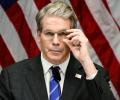
United States Treasury Secretary Scott Bessent has warned that the secondary tariffs on India could go up if 'things don't go well' during talks between President Donald Trump and Russian President Vladimir Putin in Alaska on Friday.
Wholesale price inflation (WPI) stayed in negative territory for the second consecutive month at (-) 0.58 per cent in July, as prices of food articles and fuel saw deflation, even though prices of manufactured items increased, government data showed on Thursday.

A massive drone strike on the world's largest crude-processing facility operated by Saudi Arabia's Aramco has driven oil prices to their highest level in nearly four months. The attack has knocked out over half of Saudi Arabia's production as it cut 5.7 million barrels per day or over 5 per cent of the world's supply.

Stressing that wars are "very bad", Trump said that he seems to have "an ability to end them, to get people together" for which he uses the "power of the United States".
Chinese import tariffs have unwittingly come to India's assistance to help boost imports of US liquefied petroleum gas (LPG) at rates cheaper than what it pays for supplies from West Asia, according to industry sources and shipping data.

India has said it will take all steps to protect its national interests and ensure comprehensive national security in all domains after Pakistan and Saudi Arabia signed a strategic defence pact.

Saudi Arabia and Pakistan have signed a 'Strategic Mutual Defence Agreement', pledging that any aggression against either nation would be treated as an attack on both.

'The US values its relationship with India and under the strong leadership of President Donald J Trump and Prime Minister Modi, I am optimistic about the days ahead for both of our nations.'
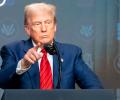
President Trump addresses questions about US imports from Russia and India's stance on purchasing Russian oil, hinting at potential tariffs.

Officials said the government-to-government engagement between the two countries on all other issues remains normal, but conceded rough spots over trade that need ironing out.

The BRICS nations have expressed concern over the proliferation of trade-restrictive actions in the form of 'indiscriminate rising' of tariffs, particularly measures used as a means of 'coercion', cautioning that such practices risk marginalising the Global South countries.

Communication channels between India and the US are open to resolve the ongoing tariff issues, and the glitch in trade ties is only temporary, given the long-term relationship between the two nations, government sources said on Wednesday. The US' 50 per cent tariffs on Indian exports to America came into effect from August 27, barring a few sectors.
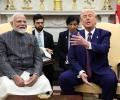
Deferment or rescheduling of the meeting assumes significance as the US has announced a staggering 50 per cent duty on Indian goods.

Russian President Vladimir Putin briefed Prime Minister Narendra Modi on his summit talks with US President Donald Trump on ending the war in Ukraine.
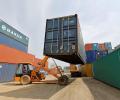
After registering a positive growth for two months, India's exports slipped into negative territory again, contracting 2.17 per cent year-on-year to $38.73 billion in May due to a fall in global petroleum prices, while trade deficit narrowed at $21.88 billion during the month.
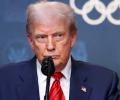
United States President Donald Trump has said there will be no trade negotiations with India until a dispute over tariffs is resolved, following his administration's decision to double tariffs on Indian imports.
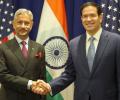
Rubio voiced "appreciation" for New Delhi's continued engagement on bilateral issues, including trade, defence and energy.

Wholesale price inflation (WPI) declined to (-) 0.13 per cent in June as prices of food articles and fuel saw deflation, along with easing in manufactured product costs, government data showed on Monday. WPI-based inflation was 0.39 per cent in May. It was 3.43 per cent in June last year.

'Just as we cannot surrender the interests of our farmers and dairy industry, Trump is also looking for markets for the produce of the farmers in the Midwest, which are his support base.'
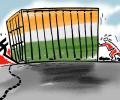
Merchandise exports to the US jumped 23.5 per cent year-on-year (Y-o-Y) to $8.3 billion in June, even as India's overall outbound shipments witnessed contraction during the month, according to the data released by the commerce department on Tuesday. The increase in outbound shipments to the US was largely driven by the rush among exporters to utilise America's pause on its plans to impose country-specific reciprocal tariffs.

Indian billionaire Gautam Adani-led group's Haifa port in Israel was unharmed by the Iranian ballistic missile attack, with cargo operations progressing unhampered, sources said. Late on Saturday night, Iran targeted Israel's Haifa port and a nearby oil refinery in response to Tel Avi's attack on Iranian nuclear and other targets earlier this week.
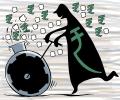
Some of the key names include: Maruti, M&M, Ashok Leyland, Britannia, Ultratech, JK Cement, Havells, Voltas, Amber, Metro, Trent, LemonTree, Indian Hotels, Niva Bupa, HDFC Life, IGL, Acme Solar, Suzlon, Swiggy, Delhivery, ICICI Bank, HDFC Bank, Bajaj Finance, Shriram Finance," according to a report by Motilal Oswal Financial Services.
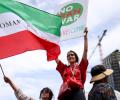
China and Russia on Sunday strongly condemned the United States air strikes on Iranian nuclear facilities, with China calling it a serious violation of the United Nations Charter that heightens tensions in West Asia, and Russia terming the strikes 'irresponsible' and asserting that they grossly violate international law, the UN Charter, and UN Security Council resolutions.

India's macroeconomic health is in a "relative goldilocks situation", and although the risk of higher landed oil prices, due to insurance cost surges and closure of choke points due to the brief Israel-Iran war, has receded, it is "too soon to sound the 'all clear' for the rest of the year", the Finance Ministry said on Friday.
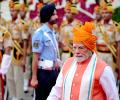
Prime Minister Narendra Modi will travel to China to attend the Shanghai Cooperation Organisation (SCO) summit, marking his first visit in over seven years. The visit signals a potential improvement in India-China relations after recent tensions.
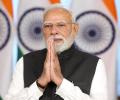
Prime Minister Narendra Modi is likely to address the UN General Assembly in September. The session will address global conflicts and trade negotiations between the US and India.
